lingvo.wikisort.org - Language
Lish (also called Lishpa or Khispi) is a Kho-Bwa language of West Kameng district, Arunachal Pradesh in India. It is closely related to Chug.
| Lish | |
|---|---|
| Lishpa, Khispi | |
| Region | Arunachal Pradesh |
| Ethnicity | Lishipa |
Native speakers | 1,500 (2017)[1] |
Language family | Sino-Tibetan?
|
| Language codes | |
| ISO 639-3 | lsh |
| Glottolog | lish1235 |
The Lish (population 1,567 in 1981) live in Dirang village, a few miles from Chug village, and in Gompatse. The Gompatse variety is not Lish proper, but is rather a lect closely related to Lish.[2]
Lish is also spoken in Khispi village.[2] Despite speaking languages closely related to Mey (Sherdukpen), the people identify as Monpa, not Mey.
According to Lieberherr & Bodt (2017),[1] Lish is spoken by 1,500 people in 3 main villages.
References
- Lieberherr, Ismael; Bodt, Timotheus Adrianus. 2017. Sub-grouping Kho-Bwa based on shared core vocabulary. In Himalayan Linguistics, 16(2).
- Blench, Roger. 2015. The Mey languages and their classification. Presentation given at the University of Sydney.
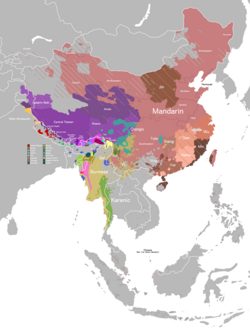
Sino-Tibetan branches | |||||
|---|---|---|---|---|---|
| Western Himalayas (Himachal, Uttarakhand, Nepal, Sikkim) |
|  | |||
| Eastern Himalayas (Tibet, Bhutan, Arunachal) | |||||
| Myanmar and Indo-Burmese border |
| ||||
| East and Southeast Asia |
| ||||
| Dubious (possible isolates) (Arunachal) |
| ||||
| Proposed groupings |
| ||||
| Proto-languages |
| ||||
Italics indicates single languages that are also considered to be separate branches. | |||||
 | This Sino-Tibetan languages-related article is a stub. You can help Wikipedia by expanding it. |
Текст в блоке "Читать" взят с сайта "Википедия" и доступен по лицензии Creative Commons Attribution-ShareAlike; в отдельных случаях могут действовать дополнительные условия.
Другой контент может иметь иную лицензию. Перед использованием материалов сайта WikiSort.org внимательно изучите правила лицензирования конкретных элементов наполнения сайта.
Другой контент может иметь иную лицензию. Перед использованием материалов сайта WikiSort.org внимательно изучите правила лицензирования конкретных элементов наполнения сайта.
2019-2026
WikiSort.org - проект по пересортировке и дополнению контента Википедии
WikiSort.org - проект по пересортировке и дополнению контента Википедии