lingvo.wikisort.org - Language
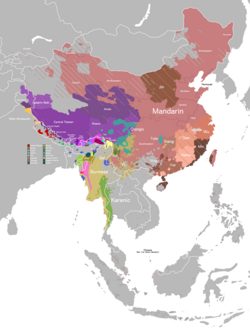
The Cai–Long (Chinese: 蔡龙语支) or Ta–Li languages are a group of Sino-Tibetan languages spoken in western Guizhou, China. Only Caijia is still spoken, while Longjia and Luren are extinct.[1] The branch was first recognized by Chinese researchers in the 1980s, with the term Cai–Long (Chinese: 蔡龙语支) first mentioned in Guizhou (1982: 43).[2]
| Cai–Long | |
|---|---|
| Ta–Li | |
| (tentative) | |
| Geographic distribution | western Guizhou, China |
| Linguistic classification | Sino-Tibetan
|
| Subdivisions | |
| Glottolog | None |
The languages are unclassified within Sino-Tibetan, and could be Sinitic or Tibeto-Burman.[1]
Languages
The Cai–Long languages are:[1]
Lexical innovations
Hölzl (2021) proposes the name Ta–Li as a portmanteau of the two lexical innovations ‘two’ and ‘pig’, respectively.
| Language | ‘two’ | ‘pig’ |
|---|---|---|
| Caijia (Hezhang) | ta55 | li21 |
| Luren (Qianxi) | ta31 | li31 |
| Longjia (Pojiao/Huaxi) | ta31 | lɛ55 |
See also
- List of unrecognized ethnic groups of Guizhou
- Greater Bai comparative vocabulary list (Wiktionary)
References
- Hölzl, Andreas. 2021. Longjia (China) - Language Contexts. Language Documentation and Description 20, 13-34.
- GMSWSB 1982 = Guizhousheng minzu shiwu weiyuanhui shibie bangongshi 贵州省民族事务委员会识别办公室. Guizhou minzu shibie ziliaoji 贵州民族识别资料集, vol. 8, longjia, caijia 龙家,蔡家. Guiyang. (Unpublished manuscript.)
Sino-Tibetan branches | |||||
|---|---|---|---|---|---|
| Western Himalayas (Himachal, Uttarakhand, Nepal, Sikkim) |
|  | |||
| Eastern Himalayas (Tibet, Bhutan, Arunachal) | |||||
| Myanmar and Indo-Burmese border |
| ||||
| East and Southeast Asia |
| ||||
| Dubious (possible isolates) (Arunachal) |
| ||||
| Proposed groupings | |||||
| Proto-languages |
| ||||
Italics indicates single languages that are also considered to be separate branches. | |||||
Текст в блоке "Читать" взят с сайта "Википедия" и доступен по лицензии Creative Commons Attribution-ShareAlike; в отдельных случаях могут действовать дополнительные условия.
Другой контент может иметь иную лицензию. Перед использованием материалов сайта WikiSort.org внимательно изучите правила лицензирования конкретных элементов наполнения сайта.
Другой контент может иметь иную лицензию. Перед использованием материалов сайта WikiSort.org внимательно изучите правила лицензирования конкретных элементов наполнения сайта.
2019-2026
WikiSort.org - проект по пересортировке и дополнению контента Википедии
WikiSort.org - проект по пересортировке и дополнению контента Википедии