lingvo.wikisort.org - Language
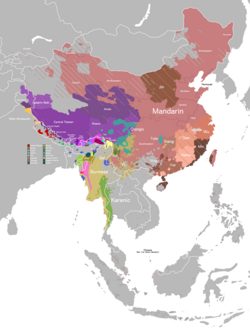
The Burmo-Qiangic or Eastern Tibeto-Burman languages are a proposed family of Sino-Tibetan languages spoken in Southwest China and Myanmar. It consists of the Lolo-Burmese and Qiangic branches, including the extinct Tangut language.
| Burmo-Qiangic | |
|---|---|
| Eastern Tibeto-Burman | |
| (proposed) | |
| Geographic distribution | China, Burma |
| Linguistic classification | Sino-Tibetan
|
| Subdivisions | |
| Glottolog | burm1265 |
Classification
Guillaume Jacques & Alexis Michaud (2011)[1] argue for a Burmo-Qiangic branch of Sino-Tibetan (Tibeto-Burman) with two primary subbranches, Qiangic and Lolo-Burmese. Similarly, David Bradley (2008)[2] proposes an Eastern Tibeto-Burman branch that includes Burmic (a.k.a. Lolo-Burmese) and Qiangic. Bradley notes that Lolo-Burmese and Qiangic share some unique lexical items, even though they are morphologically quite different; whereas all Lolo-Burmese languages are tonal and analytical, Qiangic languages are often non-tonal and possess agglutinative morphology. However, the position of Naic is unclear, as it has been grouped as Lolo-Burmese by Lama (2012), but as Qiangic by Jacques & Michaud (2011) and Bradley (2008).
Sun (1988) also proposed a similar classification that grouped Qiangic and Lolo-Burmese together.
Jacques' & Michaud's (2011) proposed tree is as follows.
| Burmo‑Qiangic |
| |||||||||||||||||||||
Bradley's (2008) proposal is as follows. Note that Bradley calls Lolo-Burmese Burmic, which is not to be confused with Burmish, and calls Loloish Ngwi.
| Eastern Tibeto‑Burman |
| ||||||||||||
However, Chirkova (2012)[3] doubts that Qiangic is a valid genetic unit, and considers Ersu, Shixing, Namuyi, and Pumi all as separate Tibeto-Burman branches that are part of a Qiangic Sprachbund, rather than as part of a coherent Qiangic phylogenetic branch. This issue has also been further discussed by Yu (2012).[4]
Lee & Sagart (2008)[5] argue that Bai is a Tibeto-Burman language that has borrowed very heavily from Old Chinese. Lee & Sagart (2008) note that word relating to rice and pig agriculture tend to be non-Chinese, and that the genetic non-Chinese layer of Bai shows similarities with Proto-Loloish.
Branches
Yu (2012:206–207)[4] lists the following well-established coherent branches (including individual languages, in italics below) that could likely all fit into a wider Burmo-Qiangic group, in geographical order from north to south.
Additionally, Tangut, now extinct, is generally classified as a Qiangic language.
Yu (2012:215-218)[4] notes that Ersuic and Naic languages could possibly group together, since they share many features with each other that are not found in Lolo-Burmese or other Qiangic groups.
Proto-language reconstructions for some of these branches include:
- Proto-Rma (Sims 2017)[8]
- Proto-Prinmi (Sims 2017)[8]
- Proto-Ersuic (Yu 2012)[4]
- Proto-Naish (Jacques & Michaud 2011)[1]
- Proto-Lolo-Burmese (Matisoff 2003)[9]
- Proto-Bai (Wang 2006)[10]
Lexical evidence
Jacques & Michaud (2011)[1][11] list the following lexical items as likely Burmo-Qiangic lexical innovations.
| Gloss | rGyalrong | Tangut | Na | Proto-Naish | Burmese | Achang | Hani |
|---|---|---|---|---|---|---|---|
| copula | ŋu | ŋwu2 | ŋi˩˧ | ? | hnang2 | - | ŋɯ˧˩ |
| star | ʑŋgri | gjịj1 | kɯ˥ | *kri | kray2 | khʐə˥ | a˧˩gɯ˥ |
| forget | jmɯt | mjɨ̣2 | mv̩.phæL+MH | *mi | me1 | ɲi˧˥ | ɲi˥ |
| be ill | ngo < *ngaŋ | ŋo2 | gu˩ | *go | |||
| flint | ʁdɯrtsa | - | tse.miH | *tsa | |||
| to hide | nɤtsɯ | - | tsɯ˥ (Naxi) | *tsu | |||
| to swallow | mqlaʁ | - | ʁv̩˥ | *NqU < *Nqak | |||
| dry | spɯ | - | pv̩˧ | *Spu | |||
| thick | jaʁ | laa1 | lo˧˥ | *laC2 | |||
| jump | mtsaʁ | - | tsho˧ | *tshaC2 | |||
| winter | qartsɯ | tsur1 | tshi˥ | *tshu | choŋ3 | tɕhɔŋ˧˩ | tshɔ˧˩ga̱˧ |
| knee | tə-mŋɑ (Situ) | ŋwer2 | ŋwɤ.koH | *ŋwa | |||
| sun | ʁmbɣi | be2 | bi˧ (Naxi) | *bi |
See also
References
- Jacques, Guillaume, and Alexis Michaud. 2011. "Approaching the historical phonology of three highly eroded Sino-Tibetan languages." Diachronica 28:468–498.
- Bradley, David. 2008. The Position of Namuyi in Tibeto-Burman. Paper presented at Workshop on Namuyi, Academia Sinica, Taiwan, 2008.
- Chirkova, Katia (2012). "The Qiangic Subgroup from an Areal Perspective: A Case Study of Languages of Muli." In Languages and Linguistics 13(1):133–170. Taipei: Academia Sinica. Archived 2015-06-08 at WebCite
- Yu, Dominic. 2012. Proto-Ersuic. Ph.D. dissertation. Berkeley: University of California, Berkeley, Department of Linguistics.
- Lee, Y.-J., & Sagart, L. (2008). No limits to borrowing: The case of Bai and Chinese. Diachronica, 25(3), 357–385.
- Chirkova, Ekaterina. 2008. On the Position of Baima within Tibetan: A Look from Basic Vocabulary. Alexander Lubotsky, Jos Schaeken and Jeroen Wiedenhof. Rodopi, pp.23, 2008, Evidence and counter-evidence: Festschrift F. Kortlandt. <halshs-00104311>
- Gong Xun (2015). How Old is the Chinese in Bái? Reexamining Sino-Bái under the Baxter-Sagart reconstruction. Paper presented at the Recent Advances in Old Chinese Historical Phonology workshop, SOAS, London.
- Sims, Nathaniel. 2017. The suprasegmental phonology of proto-Rma (Qiang) in comparative perspective. Presented at the 50th International Conference on Sino-Tibetan Languages and Linguistics, Beijing, China.
- Matisoff, James A. (2003), Handbook of Proto-Tibeto-Burman: System and Philosophy of Sino-Tibetan Reconstruction, Berkeley: University of California Press, ISBN 978-0-520-09843-5.
-
- Wang, Feng (2006). Comparison of languages in contact: the distillation method and the case of Bai. Language and Linguistics Monograph Series B: Frontiers in Linguistics III. Taipei: Institute of Linguistics, Academia Sinica. ISBN 986-00-5228-X.
- Jacques & Michaud (2011), appendix p.7
- Bradley, David. 1997. "Tibeto-Burman languages and classification". In D. Bradley (Ed.), Tibeto-Burman languages of the Himalayas (Papers in South East Asian linguistics No. 14) pp. 1–71, Canberra: Pacific Linguistics. ISBN 978-0-85883-456-9.
- Bradley, David. 2008. The Position of Namuyi in Tibeto-Burman. Paper presented at Workshop on Namuyi, Academia Sinica, Taiwan, 2008.
- Jacques, Guillaume, and Alexis Michaud. 2011. "Approaching the historical phonology of three highly eroded Sino-Tibetan languages." Diachronica 28:468-498.
- Lama, Ziwo Qiu-Fuyuan (2012), Subgrouping of Nisoic (Yi) Languages, thesis, University of Texas at Arlington (archived)
- Sūn, Hóngkāi 孙宏开. 1988. Shilun woguo jingnei Zang-Mianyude puxi fenlei 试论我国境内藏缅语的谱系分类. (A classification of Tibeto-Burman languages in China). In: Tatsuo Nishida and Paul Kazuhisa Eguchi (eds.), Languages and history in East Asia: festschrift for Tatsuo Nishida on the occasion of his 60th birthday 61-73. Kyoto: Shokado.
External links
- Burmo-Qiangic (Sino-Tibetan Branches Project)
Sino-Tibetan branches | |||||
|---|---|---|---|---|---|
| Western Himalayas (Himachal, Uttarakhand, Nepal, Sikkim) |
|  | |||
| Eastern Himalayas (Tibet, Bhutan, Arunachal) | |||||
| Myanmar and Indo-Burmese border |
| ||||
| East and Southeast Asia |
| ||||
| Dubious (possible isolates) (Arunachal) |
| ||||
| Proposed groupings | |||||
| Proto-languages |
| ||||
Italics indicates single languages that are also considered to be separate branches. | |||||
На других языках
- [en] Burmo-Qiangic languages
[fr] Langues birmano-qianguiques
Les langues birmano-qianguiques ou tibéto-birmane orientales sont une famille proposée des langues sino-tibétaines, parlées au Sud-Ouest de la Chine et en Birmanie (ou Myanmar). Cette famille est constituée des branches lolo-birmanes et na-qianguiques, incluant également le tangoute, éteint.Другой контент может иметь иную лицензию. Перед использованием материалов сайта WikiSort.org внимательно изучите правила лицензирования конкретных элементов наполнения сайта.
WikiSort.org - проект по пересортировке и дополнению контента Википедии