lingvo.wikisort.org - Language
The Naga languages are a geographic and ethnic grouping of languages under the Kuki-Chin-Naga languages, spoken mostly by Naga peoples.[1]
| Naga languages | |
|---|---|
| (geographic / cultural) | |
| Ethnicity | Naga people |
| Geographic distribution | India, Myanmar, China? |
| Linguistic classification | Sino-Tibetan
|
| Subdivisions |
|
| Glottolog | naga1409 |
Northern Naga languages do not fall within the group, in spite of being spoken by Naga groups; instead, these form part of the Sal languages within Sino-Tibetan,[2] while Southern Naga languages form a branch within Kuki-Chin languages subfamily.[3]
Classification
Angami-Ao
Angami-Pochuri
The Angami-Pochuri languages:[4]
Central Naga (Ao)
The Central Naga languages:[5]
- Ao language
- Chungli Ao
- Mongsen Ao
- Changki
- Dordar (Yacham)
- Longla
- Lotha (Lhota)
- Sangtam ('Thukumi')
- Kizare
- Pirr (Northern Sangtam)
- Phelongre
- Thukumi (Central Sangtam)
- Photsimi
- Purr (Southern Sangtam)
- Yimchingric
- Yimkhiungrü ('Yachumi')
- Para
- Makuric
Koki is a "Naga" language spoken in and around Leshi Township, Myanmar that could possibly classify as Tangkhulic languages or Ao languages.
Tangkhul-Maring
The Tangkhul-Maring languages:[6]
- Tangkhulic
- Tangkhul
- Somra
- Akyaung Ari
- Kachai
- Huishu
- Tusom
- Maringic
- Khoibu
- Maring
Western Naga (Zemeic)
The Western Naga (Zemeic) languages:[7]
See also
- Northern Naga languages
- Zakhring language
- Nagamese Creole
References
- "Naga Languages".
- "Northern Naga Languages". Archived from the original on 2019-08-12. Retrieved 2019-09-30.
-
- Peterson, David. 2017. "On Kuki-Chin subgrouping." In Picus Sizhi Ding and Jamin Pelkey, eds. Sociohistorical linguistics in Southeast Asia: New horizons for Tibeto-Burman studies in honor of David Bradley, 189-209. Leiden: Brill
- "Glottolog 4.0 - Angami-Pochuri". glottolog.org.
- "Glottolog 4.0 - Central Naga". glottolog.org.
- "Glottolog 4.0 - Tangkhul-Maring". glottolog.org.
- "Glottolog 4.0 - Zemeic". glottolog.org.
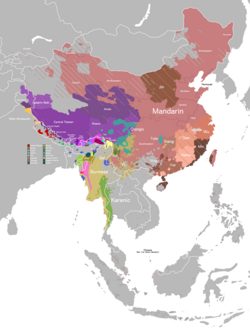
Sino-Tibetan branches | |||||
|---|---|---|---|---|---|
| Western Himalayas (Himachal, Uttarakhand, Nepal, Sikkim) |
|  | |||
| Eastern Himalayas (Tibet, Bhutan, Arunachal) | |||||
| Myanmar and Indo-Burmese border |
| ||||
| East and Southeast Asia |
| ||||
| Dubious (possible isolates) (Arunachal) |
| ||||
| Proposed groupings | |||||
| Proto-languages |
| ||||
Italics indicates single languages that are also considered to be separate branches. | |||||
Текст в блоке "Читать" взят с сайта "Википедия" и доступен по лицензии Creative Commons Attribution-ShareAlike; в отдельных случаях могут действовать дополнительные условия.
Другой контент может иметь иную лицензию. Перед использованием материалов сайта WikiSort.org внимательно изучите правила лицензирования конкретных элементов наполнения сайта.
Другой контент может иметь иную лицензию. Перед использованием материалов сайта WikiSort.org внимательно изучите правила лицензирования конкретных элементов наполнения сайта.
2019-2026
WikiSort.org - проект по пересортировке и дополнению контента Википедии
WikiSort.org - проект по пересортировке и дополнению контента Википедии