lingvo.wikisort.org - Language
Shö is a Kuki-Chin language dialect cluster of Burma and Bangladesh. There are perhaps three distinct dialects, Asho (Khyang), Chinbon, and Shendu.
| Shö | |
|---|---|
| Native to | Burma, Bangladesh |
| Ethnicity | Asho Chin |
Native speakers | (50,000 cited 1983–2011)[1] plus an unknown number of Shendu |
Language family | Sino-Tibetan
|
| Language codes | |
| ISO 639-3 | Variously:cnb – Chinbon Chincsh – Asho Chinshl – Shendu |
| Glottolog | chin1478 Chinbon Chinasho1236 Asho Chinshen1247 Shendu |
Mayin and Longpaw are not mutually intelligible, but have been subsumed under the ISO code for Chinbon because Mayin-Longpaw speakers generally understand Chinbon.[2] Minkya is similarly included because most Minkya speakers understand Mayin.[3]
Geographical distribution
Chinbon (Uppu) is spoken in the following townships of Myanmar.[4]
- Chin State: Kanpetlet and Paletwa townships
- Magway Region: Saw and Sidoktaya townships
- Rakhine State: Minbya township
Asho is spoken in Ayeyarwady Region, Bago Region, and Magway Region, and Rakhine State, Myanmar.
VanBik (2009:38)[5] lists the following Asho dialects.
- Settu (spoken from Sittwe to Thandwe — mostly Sittwe to Ann)
- Laitu (spoken in Sidoktaya Township)
- Awttu (spoken in Mindon Township)
- Kowntu (spoken in Ngaphe, Minhla, Minbu)
- Kaitu (spoken in Pegu, Mandalay, Magway, etc.)
- Lauku (spoken in Myepone, Kyauk Phyu, Ann)
Shendu is spoken in Mizoram, India.
Phonology
The Asho dialect (K’Chò) has 26 to 30 consonants and ten to eleven vowels depending on the dialect.[6]
| Labial | Dental/ Alveolar |
Palatal | Velar | Glottal | ||
|---|---|---|---|---|---|---|
| Plosive | plain | p pʰ b | t̪ t̪ʰ d | k kʰ ɡ | ʔ | |
| implosive | ɓ | ɗ | ||||
| Nasal | m m̥ | n n̥ | ɲ ɲ̊ | ŋ ŋ̊ | ||
| Fricative | s sʰ z | ʃ | h ɦ | |||
| Lateral | l ɬ | |||||
| Approximant | w | j | ||||
- Voiced plosives /b d ɡ z/ are only heard in the Plains dialect.
- In the Plains dialect, dental plosives /t̪ t̪ʰ/ are pronounced as alveolar [t tʰ], along with /d/ being only alveolar.
- Velar plosives /k kʰ/ may be palatalized as affricates [tʃ tʃʰ] before front vowels.
- In some dialects a voiceless [j̊] is heard in place of /ʃ/.
- /j/ may also be heard as a fricative [ʒ] in free variation among dialects.
| Front | Center | Back | |||
|---|---|---|---|---|---|
| Close | i / ˠi | ʉ | u | ||
| Near-close | ɪ | ʏ | ʊ | ||
| Close-mid | e | (ə̆) | ɤ | o | |
| Open-mid | ɛ | ɔ | |||
| Open | a | ||||
Diphthongs: ei, ai, au
- Sounds /ʏ ʉ/ only occur in the Hill dialect. In the Plains dialect, /ʊ u/ is heard in place of /ʏ ʉ/.
- An shortened [ə̆] is heard in unstressed syllables.
- /ɤ/ can sometimes be heard as more central [ɘ].
- A prevelarized /ˠi/ occurs in the Plains dialect.
Morphology
Similar to other Kukish languages, many Asho verbs have two distinct stems. This stem alternation is a Proto-Kukish feature, which has been retained to different degrees in different Kukish languages.[7]
References
- Chinbon Chin at Ethnologue (18th ed., 2015) (subscription required)
Asho Chin at Ethnologue (18th ed., 2015) (subscription required)
Shendu at Ethnologue (18th ed., 2015) (subscription required) - "Change Request Documentation For: 2014-063". SIL International. Archived from the original on 2015-05-12.
- "Change Request Documentation For: 2014-062". SIL International. Archived from the original on 2015-05-12.
- Ethnologue
- VanBik, Kenneth (2009). Proto-Kuki-Chin: A Reconstructed Ancestor of the Kuki-Chin Languages. UC Berkeley. ISBN 0-944613-47-0.
- Tignor, Daniel (2018). A Phonology of Hill (kone-Tu) Asho (MA thesis). University of North Dakota.
- Kee Shein Mang (2006). A Syntactic and Pragmatic Description of Verb Stem Alternation in K’chò, a Chin Language (PDF) (MA thesis). Payap University. Archived from the original (PDF) on 2012-05-26.
Sino-Tibetan branches | |||||
|---|---|---|---|---|---|
| Western Himalayas (Himachal, Uttarakhand, Nepal, Sikkim) |
| 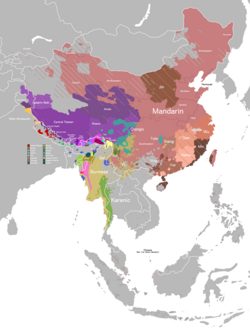 | |||
| Eastern Himalayas (Tibet, Bhutan, Arunachal) | |||||
| Myanmar and Indo-Burmese border |
| ||||
| East and Southeast Asia |
| ||||
| Dubious (possible isolates) (Arunachal) |
| ||||
| Proposed groupings |
| ||||
| Proto-languages |
| ||||
Italics indicates single languages that are also considered to be separate branches. | |||||
 Languages of Bangladesh Languages of Bangladesh | |
|---|---|
| Official language | |
| Indo-European | |
| Sino-Tibetan | |
| Austroasiatic | |
| Dravidian |
|
| Afro-Asiatic | |
| Sign | |
 | This Sino-Tibetan languages-related article is a stub. You can help Wikipedia by expanding it. |
Другой контент может иметь иную лицензию. Перед использованием материалов сайта WikiSort.org внимательно изучите правила лицензирования конкретных элементов наполнения сайта.
WikiSort.org - проект по пересортировке и дополнению контента Википедии