lingvo.wikisort.org - Language
Mara is a Kuki-Chin language spoken by Mara people, mostly the Tlosaih tribe living in 30 villages of Chhimtuipui district, southern Mizoram, India and the adjacent villages in Burma.
| Mara | |
|---|---|
| Mara (Tlosaih) | |
| Pronunciation | [m̥ara] |
| Native to | Mizoram, India; Burma |
| Ethnicity | Mara people |
Native speakers | (ca. 400,000 cited 1994–2011)[1] |
Language family | |
| Dialects |
|
Writing system | Latin |
| Language codes | |
| ISO 639-3 | mrh |
| Glottolog | mara1382 |
| ELP | Mara Chin |
The Mara (Tlosaih) languages belong to the Kuki-Chin branch of the Sino-Tibetan language family. The speakers of the languages are also known as Mara (Tlosais).
Mara is a recognised language in the Mara Autonomous District Council (MADC) school curriculum. Mara is a compulsory subject for all schools up to class VII (middle school) under the Board of School Education, MADC.
Demographics
- Population: 56,574 in Saiha district, Mizoram, India (2011), 37,000 in Burma (2007).
- Region: Saiha District, Mizoram (India), Indo-Burma Border
- Alternate names: Lakher, Mara, Maram, Mira, Zao, Shendu, Khawngsai, Khyeng.
- Languages: Tlôsaih, Sizo (Chapi/Saby/Ngiaphia), Hlaipao (Vahapi, Heima and Lelai), Lyvaw (Nohro & Notlia), Lochei ochebi, Zophei (Ahnai/Vytu, Bawipa and Asah/Leita), Senthang (Khuapi/Saith a), Lautu (Awhsa/Kahno) & Saté
- Tribes: Zophei, Lautu, Senthang, Tlosai, Hlaipao and Haw Thai
Phonology
Consonants
| Labial | Dental/ Alveolar |
(Alveolo-) palatal |
Velar | Glottal | ||
|---|---|---|---|---|---|---|
| Plosive | voiceless | p | t | k | (ʔ) | |
| aspirated | pʰ | tʰ | kʰ | |||
| voiced | b | d | ||||
| Affricate | voiceless | tɕ | ||||
| aspirated | tɕʰ | |||||
| voiced | dʑ | |||||
| Fricative | voiceless | f | s | h | ||
| voiced | v | z | ||||
| Nasal | voiced | m | n | ŋ | ||
| murmured | mʱ | nʱ | ||||
| Trill | voiced | r | ||||
| voiceless | r̥ | |||||
| Lateral | voiced | l | ||||
| voiceless | l̥ | |||||
| Approximant | w | ɹ̥ | j | |||
- A glottal stop [ʔ] may occur in onsets as a result of morphological combinations.
- /t/ can be dental as [t̪] before /ɑ/ or /i/.
- /k/ can also be heard as uvular [q] before /ɑ/ or /i/.
- /s, z/ when preceding /i/ can be heard as alveolo-palatal [ɕ, ʑ].
- Pre-aspiration can also be heard among nasals as [ʱm, ʱn].
Vowels
| Front | Central | Back | ||
|---|---|---|---|---|
| Close | i | y | ɨ | u |
| i̞ | u̞ | |||
| Mid | e | ø | o | |
| Open | ɑ̝ | |||
| ɑ | ||||
- Sounds /o/ and /ɑ̝/ can be heard in free variation as [ɔ, ɐʊ] and [ʌ].[2]
Orthography
Mara alphabet (capital letters): A, AW, Y, B, CH, D, E, F, H, I, K, L, M, N, NG, O, Ô, P, R, S, T, U, V, Z
Mara alphabet (lowercase letters): a, aw, y, b, ch, d, e, f, h, i, k, l, m, n, ng, o, ô, p, r, s, t, u, v, z
Mara diphthongs: ao, yu, ai, ei, ia, i.e., ua
Grammar
Plurals
The plural form of a noun is formed by affixing one of the following terms to the end of the noun:
- zy (zeu)
- zydua (zeu-dua)
- nawh
- sahlao (sha-hlawh)
Today the Mara language has its own alphabet; words inside brackets show author N.E. Parry's transliterations from 1937.
Interrogative words in Mara
- What: Khâpa, Khâpa e, Khâpa maw
- Where: Khataih lâ, Khataih liata
- How: kheihta, kheihawhta, Khatluta, Kheihta maw
- How much?: Khazie?
- How long?: Khachâ e, Khachâ maw?
- When: Khatita, khatita e, Khâpa nota, nota, tita, nahta, pata Conj. thlaita, khati nota
- Why: Khazia, Khazia-e, Khazia maw, Khâpa vâta
- Why not: Khazia a châ vei chheih aw
- Whose: Kheihawhpa, Kheihawhpa he, Kheihawhpa-e, Kheihawhpa maw, ahy he maw
- Which: Kheihawhpa, Kheihawhpa he, Kheihawhpa-e, Kheihawhpa maw, ahy he maw
- Friend: Viasa
- Male Friend: Viasa Paw
- Female Friend: Viasa Nô
- Walk/Go: Sie (Phei ta Sie)
- Run: Arâ, â râ
- Lay: Azei
- Sleep: Amô, Azia, Apazawh, â mô, â zia, â pazawh
- See: Mo, hmô
- Sit: Â tyuh, atyuh
- Stand: Â duah, aduah
- Jump: Â pathluah, apathluah
- Hit: Â chô, achô
- Eat: Nie
- Drink: Doh
Pronouns
Singular
- 1st person: keima, kei - I
- 2nd person: nâma, na - you
- 3rd person: ano, a or ama' - he, she, it
Plural
- 1st person: eima - we
- 2nd person: nâmo, nâma - you
- 3rd person: âmo - they
Possessive Pronouns
Singular
- Keima, ei - my
- Keima eih, kei eih - mine
- Nâma, na - thy (you)
- Nâma eih, na eih - thine (yours)
- Ama, a - him, her, it
- Ama eih, a eih - his, hers, its
Plural
- Keimo - our
- Keimo eih - ours
- Nâmo - your
- Ahyrai - anyone
- Ahy tlyma - someone, a certain one
- A tlâhpi - some . . . others
- A hropa - another, others
- Ama zydua ta - all
References
- Mara at Ethnologue (18th ed., 2015) (subscription required)
- Arden, Michelle J. (2010). A phonetic, phonological, and morphosyntactic analysis of the Mara language. San Jose State University.
External links

- Maraland: The Home of the Maras on the internet
- A grammar and dictionary of the Lakher language, by Fred W. Savidge (1908) (Scanned at Internet Archive)
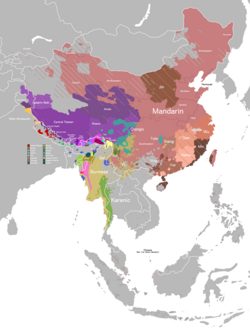
Sino-Tibetan branches | |||||
|---|---|---|---|---|---|
| Western Himalayas (Himachal, Uttarakhand, Nepal, Sikkim) |
|  | |||
| Eastern Himalayas (Tibet, Bhutan, Arunachal) | |||||
| Myanmar and Indo-Burmese border |
| ||||
| East and Southeast Asia |
| ||||
| Dubious (possible isolates) (Arunachal) |
| ||||
| Proposed groupings | |||||
| Proto-languages |
| ||||
Italics indicates single languages that are also considered to be separate branches. | |||||
| Authority control: National libraries |
|---|

На других языках
- [en] Mara language
[fr] Mara (langue)
Le mara (ou lakher) est une langue tibéto-birmane parlée dans l'État du Mizoram, en Inde et en Birmanie.[ru] Мара (язык)
Мара (также лакхер) — язык народа мара, проживающего в южной части индийского штата Мизорам и прилегающих районах Мьянмы. Относится к куки-чинской группе тибето-бирманской языковой семьи. Численность носителей составляет около 47 тыс. человек — в Индии и около 37 тыс. человек — в Мьянме (на 2007 год). Ethnologue сообщает о 22 тыс. носителях в Индии и 20 тыс. — в Мьянме (на 1997 год)[2].Другой контент может иметь иную лицензию. Перед использованием материалов сайта WikiSort.org внимательно изучите правила лицензирования конкретных элементов наполнения сайта.
WikiSort.org - проект по пересортировке и дополнению контента Википедии