lingvo.wikisort.org - Language
The Tingzhou dialect (Chinese: 汀州片; pinyin: Tīngzhōupiàn) is a group of Hakka dialects spoken in Longyan and Sanming (historically Tingzhou), southwestern Fujian. Tingzhou includes the Hakka dialects spoken in the counties originally under the jurisdiction of Tingzhou: Changting (Tingzhou), Ninghua, Qingliu, Liancheng, Wuping, Shanghang, Yongding and Mingxi. The Changting dialect is generally regarded as the representative dialect of this branch of Hakka.[1]
 | This article may be expanded with text translated from the corresponding article in Chinese. (February 2016) Click [show] for important translation instructions.
|
| Tingzhou dialect | |
|---|---|
| 汀州片 | |
| Region | western Fujian |
Native speakers | 4.8 million |
Language family | Sino-Tibetan
|
| Language codes | |
| ISO 639-3 | – |
| ISO 639-6 | tigz |
| Glottolog | ting1250 |
References
- Luo, Meizhen 罗美珍; Lin, Lifang 林立芳; Rao, Changrong 饶长溶, eds. (2004). Kèjiāhuà tōngyòng cídiǎn 客家话通用词典 (in Chinese). Guangzhou: Zhongshan daxue chubanshe.
See also
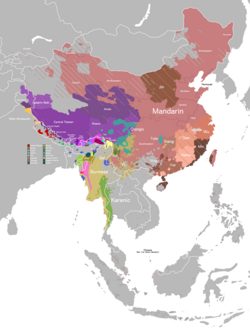
Sino-Tibetan branches | |||||
|---|---|---|---|---|---|
| Western Himalayas (Himachal, Uttarakhand, Nepal, Sikkim) |
|  | |||
| Eastern Himalayas (Tibet, Bhutan, Arunachal) | |||||
| Myanmar and Indo-Burmese border |
| ||||
| East and Southeast Asia |
| ||||
| Dubious (possible isolates) (Arunachal) |
| ||||
| Proposed groupings |
| ||||
| Proto-languages |
| ||||
Italics indicates single languages that are also considered to be separate branches. | |||||
| Major subdivisions |
| ||||||||||||||||||||||||
|---|---|---|---|---|---|---|---|---|---|---|---|---|---|---|---|---|---|---|---|---|---|---|---|---|---|
| Standardised forms |
| ||||||||||||||||||||||||
| Phonology |
| ||||||||||||||||||||||||
| Grammar |
| ||||||||||||||||||||||||
| Set phrase |
| ||||||||||||||||||||||||
| Input method |
| ||||||||||||||||||||||||
| History |
| ||||||||||||||||||||||||
| Literary forms |
| ||||||||||||||||||||||||
| Scripts |
| ||||||||||||||||||||||||
 List of varieties of Chinese List of varieties of Chinese | |||||||||||||||||||||||||
Текст в блоке "Читать" взят с сайта "Википедия" и доступен по лицензии Creative Commons Attribution-ShareAlike; в отдельных случаях могут действовать дополнительные условия.
Другой контент может иметь иную лицензию. Перед использованием материалов сайта WikiSort.org внимательно изучите правила лицензирования конкретных элементов наполнения сайта.
Другой контент может иметь иную лицензию. Перед использованием материалов сайта WikiSort.org внимательно изучите правила лицензирования конкретных элементов наполнения сайта.
2019-2026
WikiSort.org - проект по пересортировке и дополнению контента Википедии
WikiSort.org - проект по пересортировке и дополнению контента Википедии