lingvo.wikisort.org - Language
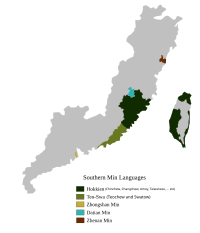
Hailufeng (海陸丰 Hai Lok Hong), or in the language itself Haklau, is a variety of Chinese mostly spoken in the Hailufeng region of Guangdong. The region includes Shanwei (Swabue), Haifeng County (Hai Hong), and Lufeng (Lok Hong) and the name 'Hailufeng' is a portmanteau of those places. It is a Southern Min (Min Nan) language, though it has close geographical and cultural ties with Teochew dialect[3][4] and similarities to Hokkien. Ethnically, the Haklau see themselves as Hokkiens and separate from the Teochews.
 | This article may be expanded with text translated from the corresponding article in Chinese. (June 2011) Click [show] for important translation instructions.
|
| Hailufeng | |
|---|---|
| Hai Lok Hong | |
| Haklau | |
| Region | Mainly in Shanwei, eastern Guangdong province. |
Native speakers | 2.65 million (2021)[1] |
Language family | Sino-Tibetan
|
| Language codes | |
| ISO 639-3 | (hlh is proposed[2]) |
| ISO 639-6 | hife |
| Glottolog | None |
| Linguasphere | 79-AAA-jik (Haifeng) |
 Haifeng dialect (inside Teochew) | |
| Haklau Min | |||||||
|---|---|---|---|---|---|---|---|
| Traditional Chinese | 海豐話 | ||||||
| Simplified Chinese | 海丰话 | ||||||
| |||||||
Differences from Teochew include the preservation of the final codas -t and -n, which are completely lost in Teochew, as well as the absence of the -oi finals.
References
- "Reclassifying ISO 639-3 [nan]: An Empirical Approach to Mutual Intelligibility and Ethnolinguistic Distinctions" (PDF). Archived from the original (PDF) on 2021-09-19.
- "Change Request Documentation: 2021-045". 31 August 2021. Retrieved 30 May 2022.
- "Cháozhōuhuà pīnyīn fāng'àn / ChaoZhou Dialect Romanisation Scheme". sungwh.freeserve.co.uk (in Chinese and English). Archived from the original on 2008-07-20. Retrieved 2008-11-06.
- Campbell, James. "Haifeng Dialect Phonology". glossika.com. Archived from the original on 2007-08-14. Retrieved 2008-11-06.
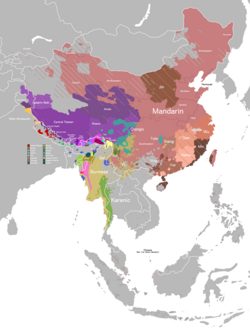
Sino-Tibetan branches | |||||
|---|---|---|---|---|---|
| Western Himalayas (Himachal, Uttarakhand, Nepal, Sikkim) |
|  | |||
| Eastern Himalayas (Tibet, Bhutan, Arunachal) | |||||
| Myanmar and Indo-Burmese border |
| ||||
| East and Southeast Asia |
| ||||
| Dubious (possible isolates) (Arunachal) |
| ||||
| Proposed groupings |
| ||||
| Proto-languages |
| ||||
Italics indicates single languages that are also considered to be separate branches. | |||||
| Datian Min |
|  | |||
|---|---|---|---|---|---|
| Hokkien |
| ||||
| Teo-Swa |
| ||||
| Zhenan Min |
| ||||
| Zhongshan Min |
| ||||
| Unclassified |
| ||||
| Major subdivisions |
| ||||||||||||||||||||||||
|---|---|---|---|---|---|---|---|---|---|---|---|---|---|---|---|---|---|---|---|---|---|---|---|---|---|
| Standardised forms |
| ||||||||||||||||||||||||
| Phonology |
| ||||||||||||||||||||||||
| Grammar |
| ||||||||||||||||||||||||
| Set phrase |
| ||||||||||||||||||||||||
| Input method |
| ||||||||||||||||||||||||
| History |
| ||||||||||||||||||||||||
| Literary forms |
| ||||||||||||||||||||||||
| Scripts |
| ||||||||||||||||||||||||
 List of varieties of Chinese List of varieties of Chinese | |||||||||||||||||||||||||
Guangdong topics | |
|---|---|
Guangzhou (capital) | |
| General |
|
| Geography |
|
| Education |
|
| Culture |
|
| Cuisine |
|
| |


Текст в блоке "Читать" взят с сайта "Википедия" и доступен по лицензии Creative Commons Attribution-ShareAlike; в отдельных случаях могут действовать дополнительные условия.
Другой контент может иметь иную лицензию. Перед использованием материалов сайта WikiSort.org внимательно изучите правила лицензирования конкретных элементов наполнения сайта.
Другой контент может иметь иную лицензию. Перед использованием материалов сайта WikiSort.org внимательно изучите правила лицензирования конкретных элементов наполнения сайта.
2019-2026
WikiSort.org - проект по пересортировке и дополнению контента Википедии
WikiSort.org - проект по пересортировке и дополнению контента Википедии