lingvo.wikisort.org - Language
Indus Kohistani (کوستَیں ژباں, Kōstaiñ) is an Indo-Aryan language spoken in the former Kohistan District of Pakistan.[3] The language was referred to as Maiyã (Mayon) or Shuthun by early researchers, but subsequent observations have not verified that these names are known locally.[4]
| Indus Kohistani | |
|---|---|
| Maiyã | |
| کوستَیں Kōstaiñ | |
 | |
| Region | Indus Kohistan (Upper Kohistan, Lower Kohistan, Kolai-Palas districts as well as Tangir and Darel valleys)[1] |
| Ethnicity | Indus Kohistanis |
Native speakers | (200,000 cited 1992)[2] |
Language family | Indo-European
|
Writing system | Perso-Arabic script (Nastaliq) |
| Language codes | |
| ISO 639-3 | mvy |
| Glottolog | indu1241 |
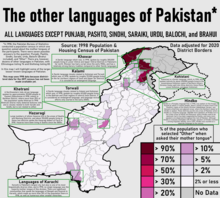 Kohistani is a minor language of Pakistan which is mainly spoken in the Kohistan region, it is given a space in this map. | |
Phonology
The phonology of Indus Kohistani varies between its major dialects as shown below.[5]
Vowels
| Front | Central | Back | |
|---|---|---|---|
| Close | i iː | u uː | |
| Mid | e eː | o oː | |
| Open | a aː |
In the Kanyawali dialect, the back vowels /u/ and /o/ are described as variants of each other, as are the front vowels /i/ and /e/.
Consonants

The consonant inventory of Indus Kohistani is shown in the chart below. (Consonants particular to the Kanyawali Dialect of Tangir and those found only in the Kohistan Dialects are color-coded respectively.)
| Labial | Coronal | Retroflex | Palatal | Velar | Uvular | Glottal | ||
|---|---|---|---|---|---|---|---|---|
| Nasal | Voiced | m | n | ɳ | ||||
| Breathy Voiced | (mʱ) | |||||||
| Stop | Voiceless | p | t | ʈ | k | (q) | ||
| Aspirated | pʰ | tʰ | ʈʰ | kʰ | ||||
| Voiced | b | d | ɖ | ɡ | ||||
| Breathy Voiced | bʱ | dʱ | ɖʱ | ɡʱ | ||||
| Affricate | Voiceless | ts | tʂ | tʃ | ||||
| Aspirated | tsʰ | tʃʰ | ||||||
| Voiced | dʒ | |||||||
| Fricative | Voiceless | f | s | ʂ | ʃ | x | h | |
| Voiced | v | z | ʐ | ʒ | ɣ | |||
| Lateral | l | |||||||
| Rhotic | Voiced | r | ɽ | |||||
| Breathy Voiced | rʱ | ɽʱ | ||||||
| Semivowel | j | w | ||||||
The phonemes /x/, /ɣ/, and /q/ are mainly found in loan words. The status of /q/ in the Kanyawali Dialect is unclear. The sounds /f, v/ can also be bilabial [ɸ, β].[6]
See also
- Kohistan District, Pakistan
- Kohistani people
- Shina Kohistani
References
- Frembgen, Jurgen Wasin (1999). Indus Kohistan An Historical and Ethnographie Outline. p. 71.
- Indus Kohistani at Ethnologue (18th ed., 2015) (subscription required)
- Jain, Danesh; Cardona, George (2007-07-26). The Indo-Aryan Languages. Routledge. p. 874. ISBN 978-1-135-79711-9.
- Zoller 2005, p. 2.
- Edelman 1983, pp. 246, 253.
- Zoller 2005, p. 36.
Bibliography
- Edelman, D. I. (1983). The Dardic and Nuristani Languages. Moscow: (Institut vostokovedenii︠a︡ (Akademii︠a︡ nauk SSSR).
- Zoller, Claus Peter (2005). A grammar and dictionary of Indus Kohistani. Vol. 1: Dictionary. Berlin: Mouton de Gruyter. ISBN 978-3-11-017947-7.
| Authority control: National libraries |
|---|

На других языках
- [en] Indus Kohistani
[fr] Kohistani de l'Indus
Le kohistani de l'Indus (ou mayã, en anglais Indus Kohistani) est une langue indo-iranienne du groupe des langues dardes, parlée par plus de 200 000 personnes[2] dans le district du Kohistan, au Pakistan.[ru] Кохистани
Кохистани — индоевропейский язык дардской ветви, распространённый в Кохистанской области, провинции Хайбер-Пахтунхва в Пакистане.Другой контент может иметь иную лицензию. Перед использованием материалов сайта WikiSort.org внимательно изучите правила лицензирования конкретных элементов наполнения сайта.
WikiSort.org - проект по пересортировке и дополнению контента Википедии