lingvo.wikisort.org - Language
Laze, rendered in Chinese as Lare (拉热)[2] and Shuitianhua (水田话), is a language of the Naish subbranch of the Naic group of languages, spoken in Muli County, western Sichuan, China.
| Laze | |
|---|---|
| Muli Shuitian | |
| Pronunciation | lɑ33 ze33 |
| Native to | China |
| Region | Sichuan |
Native speakers | 300 (2012)[1] |
Language family | Sino-Tibetan
|
| Language codes | |
| ISO 639-3 | None (mis) |
| Glottolog | laze1238 |
Laze is spoken by less than 300 fluent speakers in Xiangjiao Township 项脚乡 within Muli County (Michaud & Jacques 2012).[1]
Name
The name Laze (IPA: [lɑ33 ze33]) is likely to be a place name.[2]
Further reading
Publications are available on:
- an outline of Laze phonology, lexicon and grammar [3]
- Laze phonemes: vowels, consonants, syllable structure [4]
- the historical phonology of Laze, Na and Naxi [5]
- the Laze tone system [6]
Recordings in Laze are available from the Pangloss Collection (an online archive of languages).[7]
References
- Michaud, Alexis, and Guillaume Jacques. 2012. "The Phonology of Laze: Phonemic Analysis, Syllabic Inventory, and a Short Word List." Yuyanxue Luncong 语言学论丛 (45): 196–230.
- Guo Dalie, and He Zhiwu. 1994. Naxizu Shi (A History of the Naxi People). Chongqing: Sichuan Minzu Chubanshe.
- 黄布凡. 2009. “木里水田话概况.” 汉藏语学报 3: 30–55 (Huang Bufan. 2009. “A Survey of Muli Shuitian (Muli Shuitianhua Gaikuang).” Journal of Sino-Tibetan Linguistics (Hanzangyu Xuebao) 3: 30–55.)
- Michaud, Alexis, and Guillaume Jacques. 2012. “The Phonology of Laze: Phonemic Analysis, Syllabic Inventory, and a Short Word List.” Yuyanxue Luncong 语言学论丛 45: 196–230.
- Jacques, Guillaume, and Alexis Michaud. 2011. "Approaching the historical phonology of three highly eroded Sino-Tibetan languages: Naxi, Na and Laze." Diachronica 28:468-498.
- Michaud, Alexis. 2009. [hal.archives-ouvertes.fr/halshs-00436463/en “The Prosodic System of Muli Shuitian (Laze) (Muli Shuitianhua Shengdiao Xitong Yanjiu 木里水田话声调系统研究).”] Minority Languages of China (Minzu Yuwen 民族语文) 6: 28–33.
- Laze recordings in the Pangloss Collection
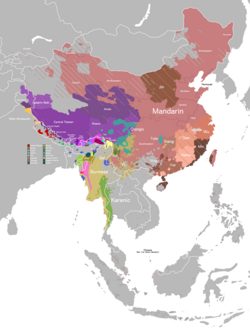
Sino-Tibetan branches | |||||
|---|---|---|---|---|---|
| Western Himalayas (Himachal, Uttarakhand, Nepal, Sikkim) |
|  | |||
| Eastern Himalayas (Tibet, Bhutan, Arunachal) | |||||
| Myanmar and Indo-Burmese border |
| ||||
| East and Southeast Asia |
| ||||
| Dubious (possible isolates) (Arunachal) |
| ||||
| Proposed groupings |
| ||||
| Proto-languages |
| ||||
Italics indicates single languages that are also considered to be separate branches. | |||||
 | This Sino-Tibetan languages-related article is a stub. You can help Wikipedia by expanding it. |
На других языках
- [en] Laze language
[fr] Laze (langue tibéto-birmane)
Le laze (en chinois 木里水田话, mùlǐ shuǐtiánhuà ou 拉热话 lārèhuà)[1] est une langue tibéto-birmane parlée dans le centre-sud de la province du Sichuan en Chine.Текст в блоке "Читать" взят с сайта "Википедия" и доступен по лицензии Creative Commons Attribution-ShareAlike; в отдельных случаях могут действовать дополнительные условия.
Другой контент может иметь иную лицензию. Перед использованием материалов сайта WikiSort.org внимательно изучите правила лицензирования конкретных элементов наполнения сайта.
Другой контент может иметь иную лицензию. Перед использованием материалов сайта WikiSort.org внимательно изучите правила лицензирования конкретных элементов наполнения сайта.
2019-2026
WikiSort.org - проект по пересортировке и дополнению контента Википедии
WikiSort.org - проект по пересортировке и дополнению контента Википедии