lingvo.wikisort.org - Language
Groma, also known as Tromowa and J'umowa, is a language spoken primarily in the lower Chumbi Valley in Tibet, with some speakers in Sikkim in India.[2] It belongs to the southern group of Tibetan languages. Its speakers identify as Tibetans.
| Groma | |
|---|---|
| Tromowa | |
| Native to | China, Bhutan and India |
| Region | Chumbi Valley region between Sikkim and Bhutan |
Native speakers | (27,000 cited 1993–2007)[1] |
Language family | |
| Language codes | |
| ISO 639-3 | gro |
| Glottolog | grom1238 |
References
- Groma at Ethnologue (18th ed., 2015) (subscription required)
- van Driem, George (2015), "Endangered Languages of South Asia", in Matthias Brenzinger (ed.), Language Diversity Endangered, Walter de Gruyter GmbH & Co KG, p. 312, ISBN 9783110905694
Further reading
- Hattaway, Paul (2004), "Groma", Peoples of the Buddhist World: A Christian Prayer Diary, William Carey Library, pp. 68–69, ISBN 9780878083619
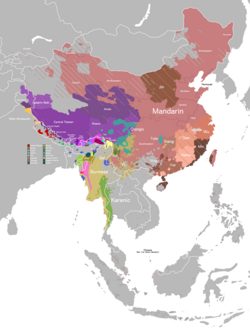
Sino-Tibetan branches | |||||
|---|---|---|---|---|---|
| Western Himalayas (Himachal, Uttarakhand, Nepal, Sikkim) |
|  | |||
| Eastern Himalayas (Tibet, Bhutan, Arunachal) | |||||
| Myanmar and Indo-Burmese border |
| ||||
| East and Southeast Asia |
| ||||
| Dubious (possible isolates) (Arunachal) |
| ||||
| Proposed groupings |
| ||||
| Proto-languages |
| ||||
Italics indicates single languages that are also considered to be separate branches. | |||||
 | This article about the culture of India is a stub. You can help Wikipedia by expanding it. |
 | This Tibet-related article is a stub. You can help Wikipedia by expanding it. |
 | This China-related article is a stub. You can help Wikipedia by expanding it. |
| This Sino-Tibetan languages-related article is a stub. You can help Wikipedia by expanding it. |
На других языках
- [en] Groma language
[fr] Groma
Le groma (autre appellation : tromowa) est une langue parlée dans la vallée de Chambi, entre le Sikkim et le Bhoutan, dans la Région autonome du Tibet, et en Inde. Elle est peut-être apparentée au spiti (en) et au tomo[réf. nécessaire].[ru] Грома (язык)
Грома (тромова; Groma, Tromowa) — один из тибето-бирманских языков восточных Гималаев.Текст в блоке "Читать" взят с сайта "Википедия" и доступен по лицензии Creative Commons Attribution-ShareAlike; в отдельных случаях могут действовать дополнительные условия.
Другой контент может иметь иную лицензию. Перед использованием материалов сайта WikiSort.org внимательно изучите правила лицензирования конкретных элементов наполнения сайта.
Другой контент может иметь иную лицензию. Перед использованием материалов сайта WikiSort.org внимательно изучите правила лицензирования конкретных элементов наполнения сайта.
2019-2026
WikiSort.org - проект по пересортировке и дополнению контента Википедии
WikiSort.org - проект по пересортировке и дополнению контента Википедии