lingvo.wikisort.org - Language
The Itbayat language or Itbayaten (also known generically as Ibatan) is an Austronesian language, in the Batanic group, spoken in the Batanes Islands, Philippines.
Austronesian language spoken in the Philippines
| Itbayat | |
|---|---|
| Ibatan | |
| Itbayaten | |
| Native to | Philippines |
| Region | Itbayat Island |
| Ethnicity | Ivatan people Yami people |
Native speakers | (3,500 cited 1996 census)[1] |
Language family | Austronesian
|
| Language codes | |
| ISO 639-3 | – |
| Glottolog | itba1237 |
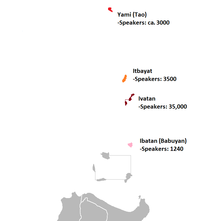 Itbayat and the other Batanic languages | |
Phonology
Vowels
/a, ɜ, i, o/
Vowels are contrasted between long and short vowels, for example as seen in the words tokod ('support') and tookod ('a kind of yam').[2]
Consonants
| Labial | Alveolar | Palatal | Velar | Uvular | Glottal | ||
|---|---|---|---|---|---|---|---|
| Nasal | m | n | ɲ | ŋ | |||
| Plosive/ Affricate |
voiceless | p | t | t͡ʃ | k | ʔ | |
| voiced | b | d | d͡ʒ | ɡ | |||
| Fricative | voiceless | (f) | s | ʁ | h | ||
| voiced | v | ɣ | |||||
| Approximant | l | j | w | ||||
| Trill | r | ||||||
- /f/ is only used in loanwords but tends to become /p/.[2]
Grammar
Pronouns
The following set of pronouns is found in the Itbayat language.[2]
| Nominative | Genitive | Locative | |||||
|---|---|---|---|---|---|---|---|
| free | bound | free | bound | ||||
| 1st person |
singular | yaken | ako | ñaken | ko | jaken | |
| dual | – | ta | – | – | – | ||
| plural | inclusive | yaten | ta | ñaten | ta | jaten | |
| exclusive | yamen | kami | ñamen | namen | jamen | ||
| 2nd person |
singular | imo | ka | nimo | mo | dimo | |
| plural | imiyo | kamo | nimiyo | miyo | dimiyo | ||
| 3rd person |
singular | – | – | niya/ña | na | dira | |
| plural | sira | sira | nira | da | dira | ||
References
- Ivatan at Ethnologue (18th ed., 2015) (subscription required)
- Yamada, Yukihiro (2002). Itbayat–English Dictionary (PDF). ELPR Publications Series A3-006. hdl:10108/75457.
Further reading
- Yamada, Yukihiro (2014). A Grammar of the Itbayat Language of the Philippines. Himeji, Japan.
| |||||||||||||||||||||||||
|---|---|---|---|---|---|---|---|---|---|---|---|---|---|---|---|---|---|---|---|---|---|---|---|---|---|
| Batanic (Bashiic) | |||||||||||||||||||||||||
| Northern Luzon |
| ||||||||||||||||||||||||
| Central Luzon |
| ||||||||||||||||||||||||
| Northern Mindoro | |||||||||||||||||||||||||
| Greater Central Philippine |
| ||||||||||||||||||||||||
| Kalamian | |||||||||||||||||||||||||
| Bilic | |||||||||||||||||||||||||
| Sangiric | |||||||||||||||||||||||||
| Minahasan | |||||||||||||||||||||||||
| Other branches |
| ||||||||||||||||||||||||
| Reconstructed | Proto-Philippine † | ||||||||||||||||||||||||
| |||||||||||||||||||||||||
Languages of the Philippines | |||||||||||||||||||||||||||||||||||
|---|---|---|---|---|---|---|---|---|---|---|---|---|---|---|---|---|---|---|---|---|---|---|---|---|---|---|---|---|---|---|---|---|---|---|---|
| Official languages | |||||||||||||||||||||||||||||||||||
| Regional languages | |||||||||||||||||||||||||||||||||||
| Indigenous languages (by region) |
| ||||||||||||||||||||||||||||||||||
| Immigrant languages | |||||||||||||||||||||||||||||||||||
| Sign languages | |||||||||||||||||||||||||||||||||||
| Historical languages |
| ||||||||||||||||||||||||||||||||||
 | This article about Philippine languages is a stub. You can help Wikipedia by expanding it. |
- v
- t
- e
Текст в блоке "Читать" взят с сайта "Википедия" и доступен по лицензии Creative Commons Attribution-ShareAlike; в отдельных случаях могут действовать дополнительные условия.
Другой контент может иметь иную лицензию. Перед использованием материалов сайта WikiSort.org внимательно изучите правила лицензирования конкретных элементов наполнения сайта.
Другой контент может иметь иную лицензию. Перед использованием материалов сайта WikiSort.org внимательно изучите правила лицензирования конкретных элементов наполнения сайта.
2019-2026
WikiSort.org - проект по пересортировке и дополнению контента Википедии
WikiSort.org - проект по пересортировке и дополнению контента Википедии