lingvo.wikisort.org - Language
Yami language (Chinese: 雅美語), also known as Tao language (Chinese: 達悟語), is a Malayo-Polynesian language spoken by the Tao people of Orchid Island, 46 kilometers southeast of Taiwan. It is a member of the Ivatan dialect continuum.
| Yami | |
|---|---|
| ciciring no Tao | |
| Native to | Taiwan |
| Ethnicity | Tao |
Native speakers | about 4000 (2012)[1] |
Language family | Austronesian
|
| Language codes | |
| ISO 639-3 | tao |
| Glottolog | yami1254 |
| ELP | Tao |
| Linguasphere | 31-CAA-a |
 Yami language is classified as Vulnerable by the UNESCO Atlas of the World's Languages in Danger | |
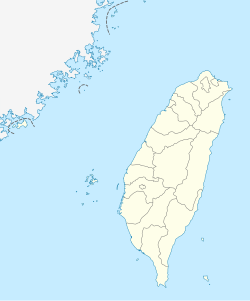  Yami Orchid Island in Taiwan  Yami Yami (Southeast Asia) | |
| Coordinates: 22°03′N 121°32′E | |
Yami is known as ciriciring no Tao 'human speech' by its native speakers. Native speakers prefer the 'Tao' name.[1]
Classification
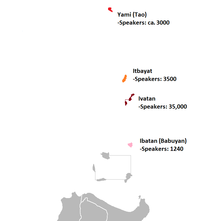
Yami is the only native language of Taiwanese aborigines that is not a member of the Formosan grouping of Austronesian; it is one of the Batanic languages also found in the northern Philippines, and as such is part of the Malayo-Polynesian branch of Austronesian.
Phonology
Yami has 20 consonants and 4 vowels:[2]
Vowels
| Front | Central | Back | |
|---|---|---|---|
| Close | i | ||
| Mid | ə | o | |
| Open | a |
- /o/ can be heard as [ʊ] after labial stop consonants.
Iraralay Yami, spoken on the north coast, distinguishes between geminative consonants (e.g., opa 'thigh' vs. oppa 'hen' form one such minimal pair).[3]
Consonants
| Labial | Alveolar | Palatal | Retroflex | Velar | Uvular | Glottal | ||
|---|---|---|---|---|---|---|---|---|
| Nasal | m | n | ŋ | |||||
| Plosive/ Affricate |
voiceless | p | t | t͡ʃ | k | (q) | ʔ | |
| voiced | b | d͡ʒ | ɖ | ɡ | ||||
| Fricative | v | ʂ | ʁ | (ɦ) | ||||
| Approximant | l | j | ɻ | w | ||||
| Trill | r | |||||||
- /k ʁ/ can also be heard as sounds [q ɦ] when between vowel /a/ intervocalically.
- Sounds /n l ʂ/ can be heard as sounds [ɲ ɮ ʃ] before /i/.
Grammar
Pronouns
The following set of pronouns is found in the Yami language.[4]
| Nominative | Genitive | Locative | |||
|---|---|---|---|---|---|
| free | bound | free | bound | ||
| 1st person singular | yaken | ko | niaken | ko | jiaken |
| 2nd person singular | imo | ka | nimo | mo | jimo |
| 3rd person singular | iya | ya | nia | na | jia |
| 1st person plural inclusive | yaten | ta, tamo, takamo | niaten | ta | jiaten |
| 1st person plural exclusive | yamen | namen | niamen | namen | jiamen |
| 2nd person plural | inio | kamo, kanio | ninio | nio | jinio |
| 3rd person plural | sira | sia | nira | da | jira |
Verbs
The following list are verbal inflections found in Yami.[5]
- Dynamic intransitive
- -om-/om- (subjunctive: N-)
- mi-
- ma-
- maN-
- maka-
- maci-/masi-/macika-/macipa-
- Stative
- ma- (subjunctive: a-)
- ka- ... -an (subjunctive: ka- ... -i)
- Dynamic
- pi-
- pa-
- paN- (subjunctive: maN-)
- paka- (subjunctive: maka-)
- paci- (subjunctive: maci-)
- Transitive
- -en (subjunctive: -a)
- -an (subjunctive: -i)
- i- (subjunctive: -an)
- Stative functioning as transitive
- ma- (subjunctive: a- ... -a)
- ka- ... -an (subjunctive: a- ... -a)
Affixes
The following is a list of affixes found in Yami.[6]
- icia- 'fellows such and such who share the same features or fate'
- ikeyka- 'even more so'
- ika- 'feel such and such because...'
- ika- 'ordinal number'
- ipi- 'multiple number'
- ji a- 'negation or emphatic'
- ka- 'company, as ... as, abstract noun'
- ka- 'and then, just now, only'
- ka- 'stative verb prefix reappearing in forming transitive verbs'
- ka- (reduplicated root) 'very'
- ka- (reduplicated root) 'animals named after certain features'
- ka- ... -an 'common noun'
- ma- ... -en 'love to do such and such'
- mapaka- 'pretend to be such and such'
- mapi- 'do such and such as an occupation'
- mi-/mala- 'kinship relationships in a group of two or three'
- mika-/mapika-/ipika- 'all, gradually, one by one'
- mala- 'taste or look like...'
- mipa- 'getting more and more...'
- mipipa- 'even more...'
- mapi-/mapa-/pa- ... -en/ipa- 'causative verb affixes'
- ni- 'perfective'
- ni- ... na 'superlative'
- noka- 'past'
- noma- 'future (remote)'
- sicia- 'present'
- sima- 'future (proximal)'
- tey- 'direction'
- tey- 'very, too'
- tey- (reduplicated root) 'amount allocated to each unit
Vocabulary
 | This section does not cite any sources. (December 2021) |
Cognates with Philippine languages
| English | Yami | Tagalog/Ilokano/Visayan, etc. |
|---|---|---|
| Person | tao | tao (Tagalog), tawo (Cebuano Vis.) |
| Mother | ina | ina[what language is this?] |
| Father | ama | ama[what language is this?] |
| Head | oo | ulo[what language is this?] |
| Yes | nohon | oho (opo)[what language is this?] |
| Friend | kagagan | kaibigan[what language is this?] |
| who | sino | sino, sin-o (Hiligaynon Vis.), hin-o (Waray Vis.) |
| they | sira | sila (Tagalog), sira/hira (Waray Vis.) |
| their | nira | nila[what language is this?] |
| offspring | anak | anak[what language is this?] |
| I (pronoun) | ko | ko, -ko (Ilokano) |
| you | ka | ka, -ka (Ilokano) |
| day | araw | araw, aldaw (Ilokano), adlaw (Cebuano Vis.) |
| eat | kanen | kain, kanen (Ilokano), kaon (all Visayan) |
| drink | inomen | inumin, inomen (Ilokano) |
| speech | ciriciring | chirichirin[what language is this?] (Itbayaten Ivatan), siling (Hiligaynon Vis., 'say'), siring (Waray Vis., 'say') |
| and | aka | saka[what language is this?] |
| ouch | Ananay | Aray, Agay (Cebuano Vis.), Annay (Ilokano) |
| home | vahay | bahay, balay (Ilokano, Cebuano Vis.) |
| piglet | viik | biik (Tagalog) |
| goat | kadling | kambing, kanding (Cebuano Vis.), kalding (Ilokano) |
| stone | vato | bato (Tagalog, all Visayan, etc.) |
| town | ili | ili (Ilokano) |
| one | ása | isa (Tagalog, Hiligaynon Vis.), maysa (Ilokano), usa (Cebuano Vis.) |
| two | dóa (raroa) | dalawa (Tagalog), duha (Cebuano), dua (Ilokano) |
| three | tílo | tatlo, tulo/tuto (Cebuano Vis.), tallo (Ilokano) |
| four | ápat | apat (Tagalog, Hiligaynon Vis.), upat (Cebuano Vis.), uppat (Ilokano) |
| five | líma | lima[what language is this?] |
| six | ánem | anim (Tagalog), innem (Ilokano), unom (Cebuano Vis.), anum (Hiligaynon Vis.) |
| seven | píto | pito[what language is this?] |
| eight | wáo | walo[what language is this?] |
| nine | síam | siyam, siam (Ilokano) |
| ten | póo | sampu (Tagalog), sangapulo (Ilokano), napulo[what language is this?] (all Visayan) |
Japanese loanwords
| English | Yami | Japanese |
|---|---|---|
| Airplane | sikoki | hikouki (飛行機) |
| Alcohol | saki | sake (酒) |
| Battleship | gengkang | gunkan (軍艦) |
| Bible | seysio | seisho (聖書) |
| Christ | Kizisto | kirisuto (キリスト) |
| Doctor | koysang | o-isha-san? (お医者さん) |
| Flashlight | dingki | denki (電気) |
| Holy Spirit | seyzi | seirei (聖霊) |
| Key | kagi | kagi (鍵) |
| Medicine | kosozi | kusuri (薬) |
| Monkey | sazo | saru (猿) |
| Motorcycle | otobay | ōtobai (オートバイ; 'auto bike') |
| Police | kisat | keisatsu (警察) |
| School | gako | gakkō (学校) |
| School bag | kabang | kaban (鞄) |
| Teacher | sinsi | sensei (先生) |
| Ticket | kipo | kippu (切符) |
| Truck | tozako | torakku (トラック; 'truck') |
Chinese loanwords
| English | Yami | Mandarin Chinese |
|---|---|---|
| Wine | potaw cio | pútáojiǔ (葡萄酒) |
See also
- Languages of Taiwan
- Taiwanese aborigines
- Tao people
- Batanic languages
- Ivatan language
References
- Rau & Dong 2006, p. 79
- Rau & Dong 2006, pp. 79–80
- Rau & Dong 2006, p. 81
- Rau & Dong 2006, p. 123
- Rau & Dong 2006, p. 135
- Rau & Dong 2006, p. 135–136
Sources
- Rau, D. Victoria; Dong, Maa-Neu (2006). 達悟語:語料、參考語法、及詞彙/ Yami Texts with Reference Grammar and Dictionary (PDF) (in Chinese and English). Taipei: Academia Sinica.
- Rau, D. Victoria 何德華; Dong, Maa-Neu 董瑪女; Chang, Ann Hui-Huan 張惠環 (2012). Dáwù yǔ cídiǎn / Yami (Tao) Dictionary 達悟語詞典 / Yami (Tao) Dictionary (in Chinese and English). Taibei shi: Guoli taiwan daxue chuban zhongxin. ISBN 978-986-03-2519-5.
- Rau, Der-Hwa 何德華; Dong, Maa-Neu 董瑪女 (2018). Dáwù yǔ yǔfǎ gàilùn 達悟語語法概論 [Introduction to Tao Grammar] (in Chinese). Xinbei shi: Yuanzhu minzu weiyuanhui. ISBN 978-986-05-5695-7 – via alilin.apc.gov.tw.
Further reading
- Lai, Li-Fang; Gooden, Shelome (2016). Acoustic Cues to Prosodic Boundaries in Yami: A First Look. Proceedings of Speech Prosody 8, May 31 – June 3, Boston, USA. doi:10.21437/SpeechProsody.2016-128.
- Lai, Li-Fang; Gooden, Shelome (2015). What Does the Question Sound Like: Exploring Wh- and Yes/No Interrogative Prosody in Yami. ICPhS.
- Lai, Li-Fang; Gooden, Shelome (2018). Tonal Hybridization in Yami-Mandarin Contact. Proceedings of the 6th Tonal Aspects of Languages. ISCA. doi:10.21437/TAL.2018-7.
External links

- Yami wordlists at the Austronesian Basic Vocabulary Database: language.psy.auckland.ac.nz/austronesian/language.php?id=254, language.psy.auckland.ac.nz/austronesian/language.php?id=335 Archived 2015-01-13 at the Wayback Machine
- Yami Language Documentation Project website – hosted by Providence University, Taiwan
- Online Yami language course – hosted by Providence University, Taiwan
- Yami Dictionary Project website Archived 2021-02-26 at the Wayback Machine – hosted by Providence University, Taiwan
- Yuán zhù mínzú yǔyán xiànshàng cídiǎn 原住民族語言線上詞典 (in Chinese) – Yami search page at the "Aboriginal language online dictionary" website of the Indigenous Languages Research and Development Foundation
- Yami teaching and leaning materials published by the Council of Indigenous Peoples of Taiwan Archived 2021-11-04 at the Wayback Machine
- Yami translation of President Tsai Ing-wen's 2016 apology to indigenous people – published on the website of the presidential office
На других языках
- [en] Yami language
[es] Lengua yami
La lengua yami es una lengua del grupo batánico hablada por el pueblo Tao de Taiwán. Este pueblo vive en la isla Orquídea, situada 46 kilómetros al sudeste de la principal isla de Taiwán. Se habla en seis pueblos: Iraralay, Yayu, Iranomilek, Iratay, Imorod e Ivalino.[fr] Yami
Le yami est une langue austronésienne parlée à Taïwan. Au nombre de 3380 (2002), ses locuteurs, les Da'o, habitent l'île de Lanyu.[it] Lingua yami
La lingua yami (雅美) o tao (caratteri cinesi: 達悟語) è la lingua parlata dal popolo Tao di aborigeni taiwanesi, che vivono sull'isola Orchid a 46 km a sudest di Taiwan. La Yami è l'unica lingua tra quelle degli indigeni di Taiwan che non fa parte della sottofamiglia delle lingue formosane, si identifica invece meglio con le lingue filippine di cui le lingue bataniche, soprattutto con la lingua ivatan parlata nell'arcipelago delle Batanes, a nord delle Filippine.[ru] Язык тао (ями)
Язык тао (самоназвание: ciciring no Tao, кит.: 達悟語), также известный как язык ями (кит.: 雅美語) — это язык малайско-полинезийской группы, на котором говорят представители народности ями (тао) с Орхидеевого острова, расположенного в 46 км к юго-востоку от Тайваня. Этот язык также относят к иватанскому диалекту.Другой контент может иметь иную лицензию. Перед использованием материалов сайта WikiSort.org внимательно изучите правила лицензирования конкретных элементов наполнения сайта.
WikiSort.org - проект по пересортировке и дополнению контента Википедии